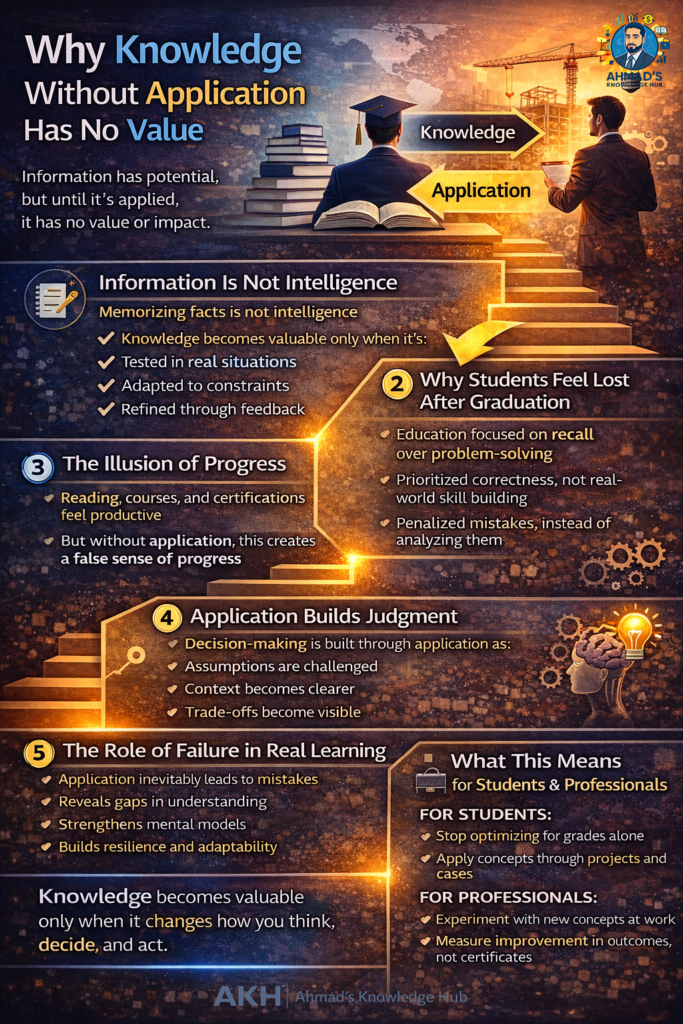
We live in an age of unprecedented access to information. Courses, degrees, certifications, podcasts, and AI tools have made knowledge abundant. Yet paradoxically, competence, impact, and real-world value remain scarce. The reason is simple: knowledge that is not applied does not transform outcomes and therefore has no value.
1. Information Is Not Intelligence
Memorizing concepts, formulas, or frameworks may help pass exams, but it does not automatically create capability. Intelligence emerges only when knowledge is:
Tested in real situations
Adapted to constraints
Refined through feedback
Until then, knowledge remains potential energy, not performance.
2. Why Students Feel Lost After Graduation
Many graduates experience a sharp disconnect between what they studied and what the workplace demands. This is not because education is useless, but because:
Learning was optimized for recall, not application
Assessments rewarded correctness, not problem-solving
Mistakes were penalized instead of analyzed
As a result, students accumulate knowledge without developing judgment.
3. The Illusion of Progress
Reading books, watching lectures, or completing certifications feels productive. But without application, this creates an illusion of progress.
True progress shows up as:
Better decisions
Faster problem resolution
Improved outcomes
Increased responsibility
If learning does not change behavior, it has not created value.
4. Organizations Don’t Pay for Knowledge, They Pay for Impact
In professional environments, value is not measured by what you know, but by:
Problems you can solve
Decisions you can support
Systems you can improve
This is why two people with the same degree often experience dramatically different career trajectories. Application separates potential from performance.
5. Application Builds Judgment
Judgment cannot be taught; it is developed.
Each time knowledge is applied:
Assumptions are challenged
Context becomes clearer
Trade-offs become visible
This process converts abstract learning into decision-making ability, a skill that is among the most valuable in a professional setting.
6. From Learning to Leverage: A Practical Framework
To turn knowledge into value, ask three questions after every learning experience:
Where can this be applied? (Workplace, project, case study, simulation)
What decision does this improve? (Planning, analysis, execution, evaluation)
What outcome should change? (Time, cost, quality, clarity, confidence)
Without these answers, learning remains incomplete.
7. The Role of Failure in Real Learning
Application inevitably leads to mistakes, and that is where real learning begins.
Failure:
Reveals gaps in understanding
Strengthens mental models
Builds resilience and adaptability
Avoiding application to avoid failure only delays growth.
8. What This Means for Students and Professionals
For students:
Stop optimizing for grades alone
Apply concepts through projects, case studies, and simulations
For professionals:
Convert learning into experiments
Measure improvement in outcomes, not certificates
In both cases, execution is the final exam.
Final Thought
Knowledge is a starting point, not a destination. Its value is realized only when it changes how you think, decide, and act. In a world overflowing with information, those who apply knowledge will always outperform those who merely possess it.
Reflection Question
What is one concept you learned recently but have not yet applied?
Experienced Financial Analyst with excellent Business, Finance, Marketing and IT skills. A motivated entrepreneur who likes to do challenging tasks. Action-oriented, results and opportunity driven having exceptional problem solving skills with strong ability to communicate effectively.
We are culturally obsessed with intensity. We love the montage in the movie where the hero trains for 18 hours a day, sweats through their clothes, and transforms overnight. We applaud the entrepreneur who pulls three all-nighters in a row to launch a product. We praise the “weekend warrior” who spends six hours at the…
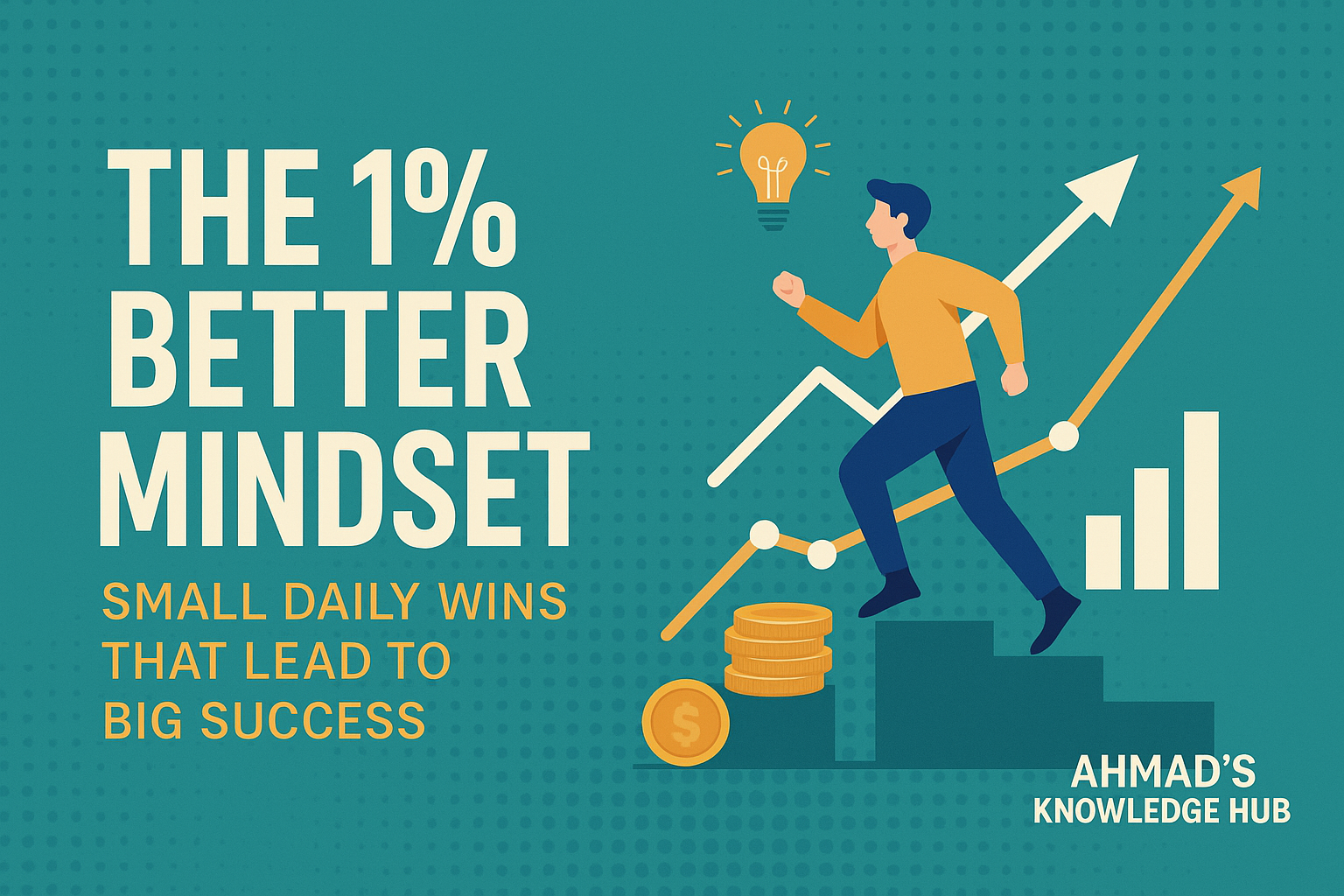
We often imagine success as something dramatic, the big breakthrough, the viral moment, the life-changing decision. But in truth, success rarely happens overnight. It’s built quietly in the small, consistent choices we make every single day. Only the 1% better mindset can create a big difference in one’s life. “Getting 1% better every day may…
(And How to Learn Them for Free) The world of work is transforming faster than ever before. Artificial Intelligence, automation, remote work, and digital transformation are reshaping what it means to be “skilled.” By 2026, millions of professionals will find that their current skills are no longer enough, while others, who invest in the right…
In a world where everything changes faster than we can imagine, technology, markets, and even the way we think, the only real skill that guarantees long-term success is the ability to keep learning. Yet, between work, family, and the endless noise of daily life, most professionals feel they “don’t have time” to learn. But the truth…
Many people step into management with excitement, armed with titles, responsibilities, and authority. But leadership… leadership is something deeper. Where management maintains systems, leadership transforms people. Where managers ensure tasks get done, leaders ignite belief, trust, and shared purpose. The truth is: every great leader was once just a manager until they changed their mindset….




Leave a comment