Every June and December, businesses around the world perform a financial audit. We scrutinize the balance sheets, analyze the marketing funnels, and calculate the ROI down to the last decimal. If a marketing campaign is leaking money, we cut it. If a product line is underperforming, we pivot.
But what happens when your spreadsheets are perfect, your strategy is sound, yet your business feels stuck? What happens when you are making money, but you are perpetually exhausted, unfulfilled, and surrounded by chaotic client relationships?
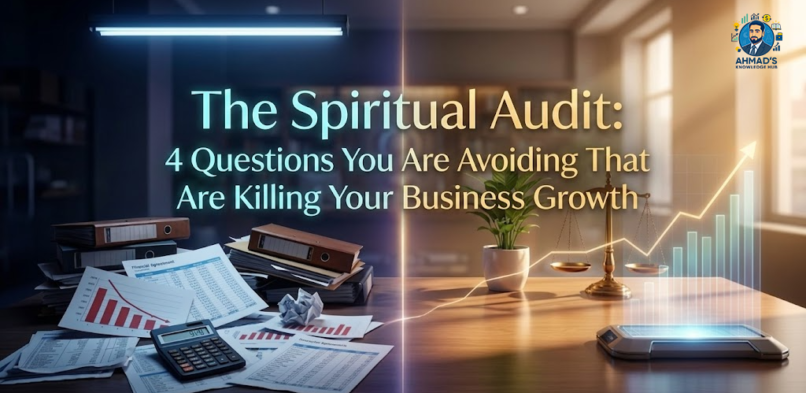
The problem is not in your math. The problem is in your spirit. While we are obsessed with tracking financial leaks, we remain completely blind to spiritual leaks. In the pursuit of scaling revenue, we ignore the foundational ethics and intentions that govern true wealth. To break through your current plateau, you do not need a new marketing hack. You need a Spiritual Audit. Here are the four uncomfortable questions you are avoiding and how answering them will unlock sustainable growth.
1. The Niyyah (Intent) Question: Are you building to serve, or to feed your ego?
Every business has a glossy “Mission Statement” on its website, but your spirit knows your actual intent (Niyyah).
Why do you really want to hit that next revenue milestone? Is it to create more value for your community, employ more people, and achieve financial freedom? Or is it to prove your worth to your peers, buy status symbols, and feed a fragile ego?
- The Problem: A business built purely on ego is incredibly brittle. When the market turns or a competitor outshines you, your foundation crumbles because your self-worth is on the line.
- The Fix: Realign your Niyyah. Dr. Allama Iqbal taught that the elevation of the Self (Khudi) comes from aligning your will with a higher, divine purpose. When your intent shifts from extracting money to serving humanity, your resilience becomes infinite.
2. The Value Question: Are you creating value, or exploiting a vulnerability?
Look honestly at your core product or service. Does it genuinely improve the life of the consumer, or does it exploit their insecurities, laziness, or lack of knowledge?
- The Problem: Modern marketing often relies on creating artificial panic. If you are selling a subpar product by manipulating your customers’ fears, you are extracting value, not creating it. This destroys Barakah (Divine Increase). You might see a short-term spike in sales, but you will suffer long-term through high refund rates, terrible reviews, and a toxic brand reputation.
- The Fix: Audit your offering. If you wouldn’t sell your product to your own family, you shouldn’t be selling it to the public. Symbiotic businesses, those that genuinely enrich their clients, scale organically through trust.
3. The Ethics Question: Where are the “Micro-Oppressions” in your operations?
You might not be committing massive corporate fraud, but spiritual leaks happen in the micro-transactions of daily business.
Are you delaying payments to your freelancers just to keep your cash flow looking healthy? Are you slightly exaggerating the capabilities of your service on sales calls? Are you underpaying your junior staff while taking massive owner distributions?
- The Problem: In Islamic economic philosophy, withholding the rightful due of a worker or engaging in mild deception creates a spiritual debt. You cannot build a blessed empire on the backs of exploited people. The friction this creates in your organization will eventually stall your growth.
- The Fix: Pay your vendors on time. Be radically transparent in your marketing. Treat your lowest-paid employee with the same dignity as your highest-paying client. Ethical purity removes friction from your operations.
4. The Faqr Question: Who are you without this business?
This is the most terrifying question for a founder. If your website crashed today, your bank accounts went to zero, and your business evaporated… who would you be?
- The Problem: If your entire identity is tied to your title as “CEO” or “Founder,” you are operating from a place of deep fear. You will make desperate, short-term decisions because any threat to the business feels like a threat to your very existence.
- The Fix: Cultivate Faqr (Spiritual Detachment). This does not mean giving up your wealth; it means not letting your wealth own you. When you internalize that you are a complete, worthy human being regardless of your company’s P&L statement, you become a fearless leader. You take calculated risks, you negotiate with a cool head, and you lead with clarity.
Conclusion: The ROI of Alignment
A Spiritual Audit is not a soft, mystical exercise. It is a hard, practical framework for removing the invisible friction that is slowing you down. When your intentions are pure, your value is real, your operations are ethical, and your identity is secure, you create a business environment where growth becomes inevitable. You stop fighting the current and start flowing with it. Do the math, check the spreadsheets, and optimize the funnels. But before you do any of that, audit your spirit.
Related Articles:




Leave a comment