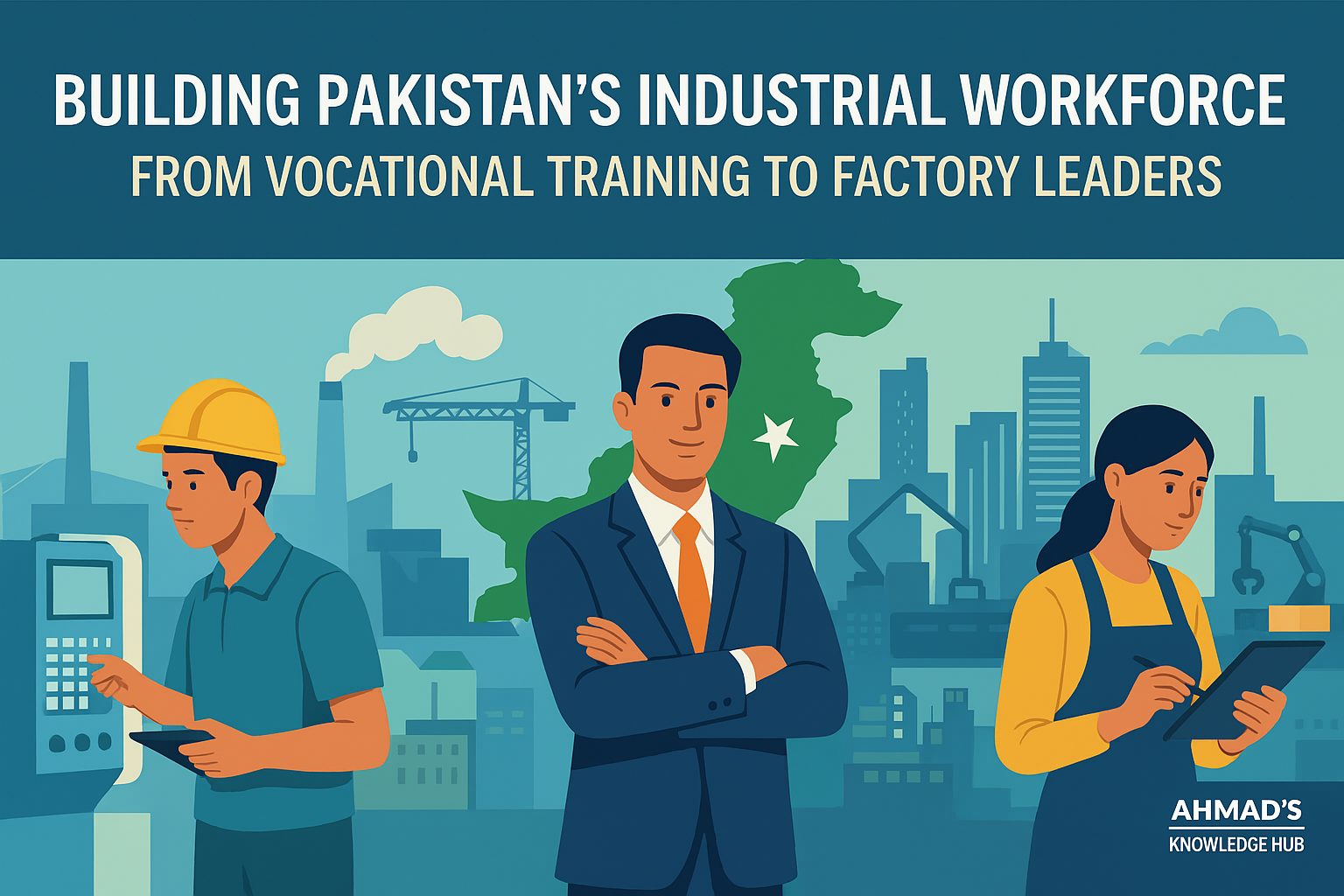
Pakistan stands at a defining point in its industrial journey. As global supply chains shift, digital transformation accelerates, and regional manufacturing hubs gain momentum, the countries that invest in their people, not just their factories, are the ones rising to the top. For Pakistan, the next wave of economic progress will not come from machines alone, but from the hands, minds, and leadership of a skilled, future-ready industrial workforce.
Today, the nation faces a paradox: millions of young people seeking meaningful employment, and thousands of industries struggling to find the right talent. Bridging this gap is not merely an economic necessity; it is a national mission. Pakistan’s path to becoming a competitive manufacturing force begins with reimagining how we train, upskill, and elevate our people from technicians and operators to supervisors, engineers, and industrial leaders.
A Workforce Waiting to Be Built
Most young Pakistanis entering the job market have limited exposure to industry-relevant skills. Traditional education often fails to align with real-world production environments, and many students never have the opportunity for hands-on learning until their first job interview. As a result, industries end up spending months and large budgets on training workers from scratch.
This mismatch slows industrial growth. Modern factories require teams equipped with technical knowledge, digital literacy, workplace discipline, safety awareness, and problem-solving abilities. Without this combination, no manufacturing sector, textile, automotive, electronics, chemicals, food, or construction can scale to global standards.
A holistic workforce strategy must therefore focus on technical expertise, character building, digital capability, and leadership development.
The New Model of Vocational Training in Pakistan
Reforming vocational training is not about creating more institutions; it is about improving the quality of existing institutions. It is about moving away from outdated classrooms and embracing industry-driven learning that reflects the global needs of manufacturing.
A modern vocational ecosystem includes:
Hands-on labs that simulate real factory floors
Partnerships with industries to design curriculum and apprenticeships
Training in emerging technologies such as automation, IoT, digital quality control, and machine maintenance
Soft skills, including teamwork, safety culture, communication, and discipline
Certification pathways aligned with international standards like NVQ, ISO, and Lean Manufacturing
When vocational education becomes practical, relevant, and industry-integrated, it produces a workforce that is employable from day one.
Transforming Workers into Factory Leaders
The journey does not end with technical skills. Pakistan must create industrial leaders, individuals who rise from shop-floor workers to supervisors, managers, and innovators who drive productivity. Factories around the world now invest heavily in leadership development for their frontline teams. Pakistan must do the same.
A factory leader of the future is someone who:
Understands production systems, safety, and quality workflows
Can monitor KPIs and identify bottlenecks
Leads teams with discipline, empathy, and accountability
Applies lean tools to eliminate waste and improve efficiency
Uses digital dashboards and data insights for decision-making
Such leadership cannot be imported from abroad; it must be cultivated within local workers, giving them a pathway to growth and dignity in their careers.
From Skill to Success: Why This Matters for Pakistan
A strong industrial workforce has a direct impact on national competitiveness. Countries like Japan, South Korea, Vietnam, and Malaysia did not rise to prominence through their raw materials; they rose through their talent.
For Pakistan, the benefits of a skilled workforce include:
Higher productivity and factory output
Attraction of foreign investment
Reduction in unemployment and underemployment
Growth in exports and industrial diversification
Emergence of local manufacturing champions
A well-trained workforce is the backbone of every industrial revolution. It is the foundation upon which factories rise, cities grow, and nations prosper.
Public-Private Synergy: The Path Forward
Building Pakistan’s workforce requires synchronized efforts between the government, industries, vocational institutes, and private training providers. The most successful models globally, Germany’s dual training system, Singapore’s SkillsFuture, and South Korea’s HRD, were built on deep collaboration.
Pakistan can replicate this success by:
Creating national skill frameworks aligned with Industry 4.0
Offering incentives for companies that train young workers
Establishing Centres of Excellence in key industrial zones
Encouraging private institutions to innovate in training
Expanding apprenticeship programs with real job guarantees
This collaboration can transform Pakistan’s youth into its greatest economic strength.
A New Industrial Identity for Pakistan
At its core, building the industrial workforce is not just an economic strategy; it is a nation-building project. When young people acquire skills, confidence, and opportunities, they not only uplift their families but also contribute to the overall well-being of the country.
The factories of tomorrow will be more automated, more digital, and more globally connected. But their success will still depend on people: skilled technicians, smart supervisors, innovative engineers, and visionary factory leaders. If Pakistan invests in its people today, by 2035 and beyond, the world will look to our nation not for raw talent, but for refined, world-class industrial expertise.
This is how Pakistan can build not just workers, but the makers and leaders of its new industrial future.
Experienced Financial Analyst with excellent Business, Finance, Marketing and IT skills. A motivated entrepreneur who likes to do challenging tasks. Action-oriented, results and opportunity driven having exceptional problem solving skills with strong ability to communicate effectively.
Across the world, nations are racing to build faster, smarter, and more sustainably. Cities are expanding, populations are rising, and the demand for high-quality housing and modern infrastructure has never been greater. In this global shift, modular construction and smart infrastructure have emerged as the game-changers, reducing cost, accelerating project timelines, and delivering world-class quality…
When nations rise, they do not rise by accident; they rise by design. Behind every developed economy lies a powerful alliance between the public and private sectors, built on trust, shared vision, and relentless execution. From South Korea’s high-tech industries to Singapore’s globally admired efficiency, public-private collaborations have been the engines of transformation. For Pakistan,…
Imagine driving through a Pakistani city in 2035, the air is cleaner, the streets are quieter, and sleek, locally made electric cars glide silently across modern highways. Charging stations replace fuel pumps, solar panels power homes and vehicles alike, and a new generation of engineers proudly say, “We built this.” That vision, once unimaginable, is…
When the world thinks of Pakistan, too often it imagines cotton, mangoes, and cricket. But what if, by 2040, the image shifts to electric cars rolling out of smart mega factories, satellites built in futuristic labs, solar panels exported to Africa, and “Made in Pakistan” stamped proudly on high-tech products used across the globe? This…
The world is rapidly transforming, and at the center of this transformation lies the digital economy. For Pakistan, a country blessed with a young population, immense talent, and growing connectivity, understanding the digital economy is no longer optional. It is the foundation for prosperity, competitiveness, and resilience in the 21st century. But what does the…



Leave a comment