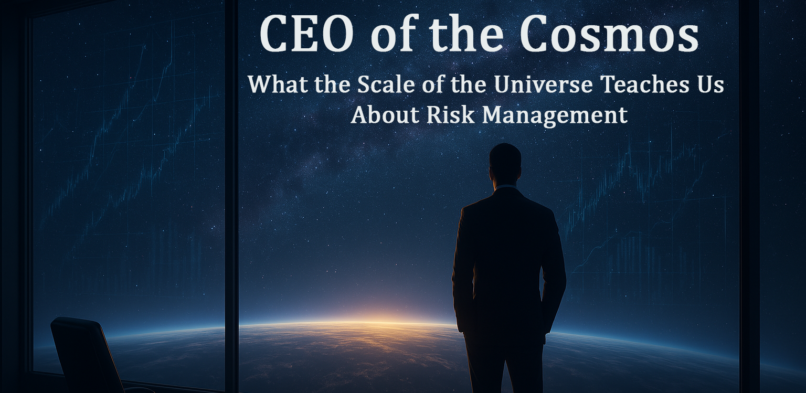
In 1968, when the Apollo 8 astronauts rounded the dark side of the Moon and saw the Earth rising as a fragile, blue marble suspended in the vast, suffocating blackness, they experienced a cognitive shift that psychologists later termed the Overview Effect.
Suddenly, national borders vanished. Political conflicts seemed petty. The fragility of the “system” (the Earth) became the top priority. Back on Earth, in the boardrooms of Lahore, Karachi, and New York, we suffer from the opposite problem. We are trapped in the Underview Effect. We are zoomed in so tight on quarterly targets, fluctuating exchange rates, and office politics that we lose the ability to calculate true risk.
As leaders, we often think our job is to manage money. But physics teaches us a deeper truth: our job is to manage energy and entropy. Here is what the scale of the universe can teach us about running a business.
1. The Overview Effect: Calibrating Your “Crisis”
In business, we often treat a missed deadline or a negative PR cycle as an existential threat. Our fight-or-flight response kicks in, cortisol floods the brain, and we make rash, short-term decisions to “stop the bleeding.”
A leader with a Cosmic Perspective utilizes the Overview Effect as a risk management tool. When you zoom out to a 10-year horizon (a mere blink in cosmic time), 90% of today’s “urgent” problems reveal themselves as noise, not signal.
The Micro-Manager sees a 5% drop in monthly sales and cuts the R&D budget in panic.
The Cosmic Strategist views the 5% drop as a natural orbital fluctuation and keeps the R&D budget, knowing that long-term survival depends on the “next big leap,” not this month’s spreadsheet.
The Lesson: Before you react to a business crisis, ask yourself: Is this an asteroid strike (an extinction-level event), or just a bit of turbulence in the atmosphere? Most leaders crash the plane trying to correct for turbulence.
2. Entropy: Why Businesses Die
The Second Law of Thermodynamics states that in an isolated system, Entropy (disorder/chaos) always increases. Things naturally fall apart. Stars run out of fuel; coffee gets cold; buildings crumble.
This is the most fundamental law of economics. A business is a system. If left to itself without the injection of new energy, it will naturally degrade into bureaucracy, inefficiency, and irrelevance. Many CEOs make the mistake of thinking a successful company will “coast.” In physics, nothing coast forever against friction.
Administrative Entropy: Without active pruning, processes become slower and more complex over time.
Market Entropy: Your innovative product from 2020 is obsolete by 2025 because the universe (and the market) moves toward higher complexity.
The Lesson: You are not just a Manager; you are an Energy Injector. Your primary role is to combat entropy by continually injecting new energy (innovation, culture, capital) into the system to maintain order.
3. The “Pale Blue Dot” Negotiation Strategy
Carl Sagan famously described Earth as a “mote of dust suspended in a sunbeam.” This realization is typically reserved for philosophy, but it can be a powerful tool in negotiation. Most business deals fail due to ego. We overvalue our position, take offense at low offers, and refuse to pivot because we don’t want to appear weak.
When you adopt the “Pale Blue Dot” mentality, you detach your Ego from the outcome. You realize that in the grand scheme of the economy, your specific title or immediate “win” is insignificant. This detachment paradoxically makes you a terrifyingly effective negotiator.
You are not desperate.
You are not triggered by aggression.
You negotiate from a place of radical objectivity.
4. Deep Time: Building a Legacy, Not a Resume
The universe operates on timescales of billions of years. Modern finance operates on a 90-day timescale (fiscal quarters). This mismatch is why we have businesses that destroy the environment or exploit workers for quick profit; they are ignoring Deep Time.
Great companies, those that become institutions, operate on “Stellar Time.” They build infrastructure, brand reputation, and culture that can outlast the founder. Look at the Japanese construction company Kongō Gumi, which operated for over 1,400 years. They didn’t survive by chasing the hottest trend of the year 578 AD. They survived by mastering their craft and respecting the long game.
Conclusion: Lead Like an Astronomer
To be a great Business Analyst or Economist in Pakistan is to understand the numbers. But to be a Visionary, you must understand the invisible forces behind the numbers. The next time you are overwhelmed by the chaos of the market, close your eyes. Zoom out. Remember that you are navigating a small vessel through a vast, chaotic ocean of variables.
Don’t fight the turbulence (Short term).
Focus on the destination (Long term).
Keep the engine running to fight the cold drift of Entropy.
Be the CEO of your own Cosmos.
Actionable Summary for Leaders
Cosmic Concept
Business Application
Overview Effect
Stop micromanaging “noise.” Focus on 5-10 year “signal.”
Entropy
If you aren’t actively innovating, your business is actively dying.
Pale Blue Dot
Remove Ego from negotiations. Objectivity wins deals.
Deep Time
Invest in assets (brand, culture) that compound over decades.
Experienced Financial Analyst with excellent Business, Finance, Marketing and IT skills. A motivated entrepreneur who likes to do challenging tasks. Action-oriented, results and opportunity driven having exceptional problem solving skills with strong ability to communicate effectively.
As 2025 unfolds, Pakistan is witnessing a remarkable shift in its business and technology ecosystem. The convergence of innovation, digital transformation, and policy support is setting the stage for long-term growth, driving new opportunities across industries. From artificial intelligence to fintech, these trends are not just reshaping businesses but also creating profound social and economic…
As the world shifts toward a greener and more sustainable future, the term “carbon credits” is increasingly becoming part of the everyday business vocabulary. But what exactly are carbon credits? And why should businesses, especially small and medium-sized enterprises (SMEs), pay attention? This quick guide breaks it down in a practical, human-friendly way. What Are…
Have you ever thought, “I wish I could earn money doing what I’m already good at”? Good news — you absolutely can. In a world where traditional 9-to-5 jobs are no longer the only path to financial stability, turning your existing skill into a business model is not just possible, it’s smart. Whether you’re good…
You’ve got a business idea, that’s great! But before you spend weeks (or months) building, marketing, and selling, it’s crucial to validate your idea. In just 24 hours, you can gain valuable insights, test demand, and avoid wasting time and money. Here’s how to do it fast and effectively. Why Validate Your Business Idea Quickly?…
🕒 Reading Time: 5 minutes Your Big Idea Doesn’t Need a Developer Anymore Have a business idea but stuck because you “don’t know how to code”? That excuse just expired. Looking for no-code tools to launch a side business? You’re in luck. In today’s digital age, anyone can start a profitable side hustle with powerful…




Leave a comment