For decades, organizational decision-making relied heavily on experience, intuition, and historical reports. While these elements still matter, they are no longer sufficient in an environment defined by speed, complexity, and uncertainty. Artificial Intelligence (AI) is fundamentally reshaping how modern organizations analyze information, evaluate options, and take action. This transformation is not about replacing human judgment; it is about augmenting it with intelligence at scale.
1. From Intuition-Based to Data-Driven Decisions
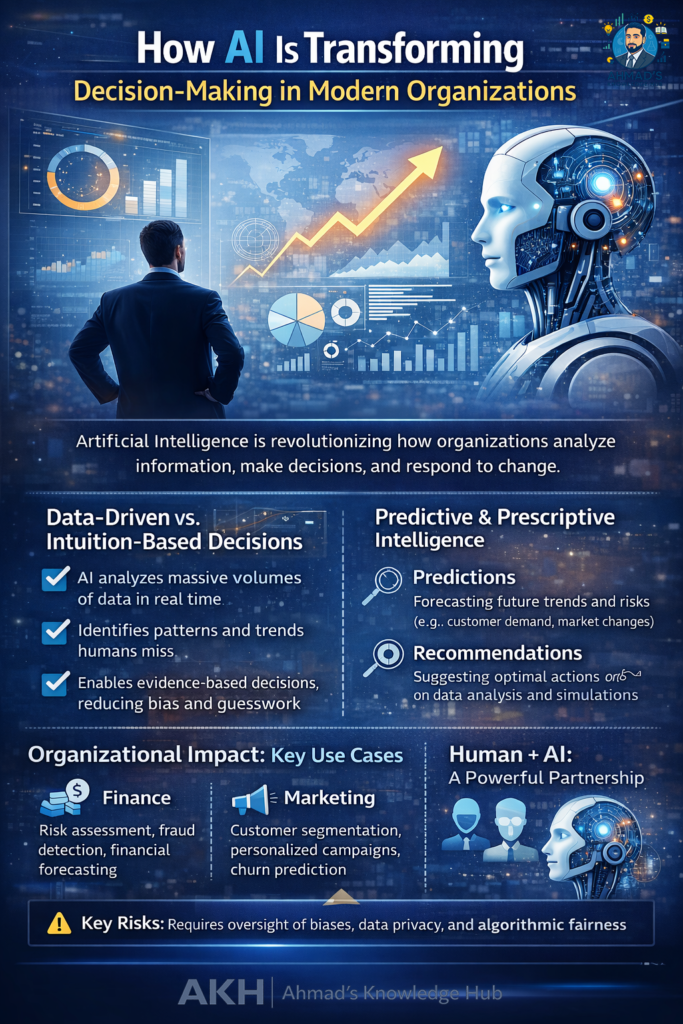
Traditional decisions often depended on limited datasets and managerial instincts. AI changes this by enabling organizations to process millions of data points in real time, uncovering patterns that humans cannot detect. AI-powered systems:
Analyze customer behavior, operations, and financial data simultaneously
Reduce bias caused by assumptions or incomplete information
Enable evidence-based decisions rather than opinion-based debates
For business students, this explains why data literacy is now a core managerial skill, not just a technical one.
2. Speed as a Strategic Advantage
In modern markets, speed of decision-making is a competitive advantage. AI systems can:
Generate insights instantly
Simulate multiple scenarios
Recommend optimal actions within seconds
For example, pricing decisions, inventory adjustments, or fraud detection no longer require weeks of analysis. AI enables near real-time responsiveness, allowing organizations to act while opportunities still exist.
3. Predictive and Prescriptive Intelligence
AI not only explains what happened, but it also helps organizations understand what is likely to happen next and what should be done about it.
Predictive analytics forecasts demand, risks, and customer behavior
Prescriptive analytics recommends actions based on those forecasts
This is a critical shift for MBA and management students: decisions are increasingly forward-looking, not backward-looking.
4. Decision Support, Not Decision Replacement
A common misconception is that AI replaces managers. In reality, AI acts as a decision support system, while humans remain responsible for:
Strategic judgment
Ethical considerations
Contextual understanding
Accountability
The strongest organizations combine:
AI for analysis
Humans for wisdom
This hybrid decision model is becoming the gold standard.
5. Functional Impact Across the Organization
Finance
Cash flow forecasting
Risk assessment
Fraud detection
Marketing
Customer segmentation
Personalized campaigns
Demand forecasting
Operations
Process optimization
Supply chain planning
Quality control
Human Resources
Workforce planning
Performance analytics
Talent retention insights
This cross-functional impact explains why AI is no longer an “IT initiative”; it is a business transformation initiative.
6. What This Means for Students and Professionals
For students and professionals, the implications are clear:
Managers must ask better questions of data
Business graduates must understand how AI informs decisions
Technical professionals must learn the business context and impact
The future belongs to professionals who can bridge business thinking with technological intelligence.
7. Risks and Responsible Decision-Making
AI-driven decisions are powerful but not risk-free. Organizations must manage:
Data quality issues
Algorithmic bias
Over-reliance on automated recommendations
Ethical and regulatory concerns
Responsible organizations implement governance frameworks to ensure AI supports fair, transparent, and accountable decision-making.
Final Thought
AI is not changing decision-making by removing humans from the process; it is changing it by raising the standard of thinking. Organizations that learn how to combine human judgment with machine intelligence will outperform those that rely on either one alone. The real competitive advantage is not AI itself, but how intelligently it is used.
Reflection Question for Readers
Are your decisions driven by assumptions and habits, or by insight and evidence?
Experienced Financial Analyst with excellent Business, Finance, Marketing and IT skills. A motivated entrepreneur who likes to do challenging tasks. Action-oriented, results and opportunity driven having exceptional problem solving skills with strong ability to communicate effectively.
Introduction: A Time of Tremendous Change Artificial Intelligence is everywhere—from automating tasks at work to suggesting the next movie to watch. It’s fast, intelligent, and evolving daily. With so much noise around AI, it might feel like humans are becoming replaceable. But here’s the truth: AI still can’t do many of the things that make…
⏱️ Reading Time: ~5 minutes Imagine being able to cut thousands from your software bills — without compromising on quality.Thanks to the rise of AI, you no longer need to break the bank to work smart. Whether you’re a student, solopreneur, content creator, or small business owner, there’s a growing list of powerful AI tools…
Imagine creating your marketing plan, product designs, and customer service scripts — all with the help of an AI assistant. That’s no longer a futuristic dream — it’s happening right now. In 2025, generative AI is not just for big corporations or tech geeks. It’s rapidly becoming the backbone of small businesses. It has been…
Artificial Intelligence (AI) is no longer just a futuristic concept — it’s actively reshaping the way we live, work, and interact with technology. From virtual assistants to intelligent business systems, AI has proven to be a game-changer across industries. Below, we explore five major advantages of AI and how it’s transforming the modern world. 1….

Leave a comment