Introduction: A Future We Can No Longer See Clearly
For decades, individuals and businesses have operated under a simple assumption: The future, while uncertain, was still predictable enough to plan for.
Students pursued degrees expecting stable careers. Companies made long-term investments expecting steady returns. Leaders built strategies based on trends that evolved gradually.
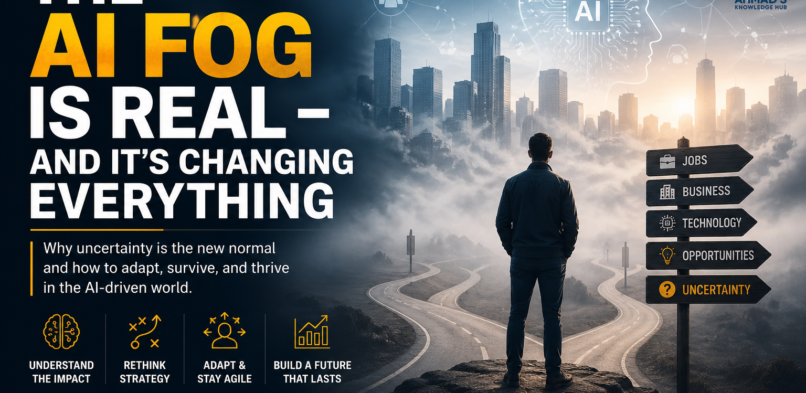
Today, that assumption is breaking. We are entering an era where artificial intelligence is not just transforming industries, it is obscuring the future itself. This phenomenon can be described as “The AI Fog.”
What Is the AI Fog?
The “AI Fog” refers to a new kind of uncertainty created by rapid advancements in artificial intelligence. This is not a traditional business risk where outcomes can be estimated. Instead, it is deep uncertainty, where:
The range of possible outcomes is extremely wide
The speed of change is unpredictable
The rules of competition are constantly shifting
In simple terms: 👉 We no longer know what the world will look like in 5–10 years, and neither do the experts.
From Predictable Risk to True Uncertainty
Historically, decision-making relied on risk assessment:
Businesses could forecast demand
Professionals could estimate career growth
Investors could model future returns
But AI has changed the equation. We are now dealing with uncertainty, not risk.
Risk
Uncertainty
Measurable
Unpredictable
Probabilities known
Outcomes unknown
Can be modeled
Cannot be reliably forecast
This shift is critical because it makes traditional planning tools less effective.
Why the AI Fog Is So Powerful
1. Rapid Technological Acceleration
AI is evolving faster than any previous technology:
Generative AI can write, design, and analyze
Automation is replacing cognitive tasks
AI agents are beginning to perform complex workflows
This speed makes it difficult to anticipate what comes next.
2. Disruption Across Multiple Industries
Unlike past innovations, AI is not limited to one sector. It is simultaneously affecting:
Software and IT
Finance and consulting
Healthcare and education
Manufacturing and logistics
No industry is fully insulated.
3. Uncertain Job Market Dynamics
One of the biggest questions today is:
👉 Will AI eliminate jobs or create more?
The reality is unclear.
Some roles may disappear, while others may evolve or emerge. However, the timeline and scale of these changes remain unknown, making career planning increasingly complex.
4. Weakening of Competitive Advantages
Traditional business advantages such as:
Expertise
Proprietary processes
Software capabilities
These are becoming easier to replicate with AI.
This means: 👉 Competitive moats are shrinking faster than ever before.
How the AI Fog Is Changing Decision-Making
1. Long-Term Investments Are Becoming Riskier
Large commitments such as:
Expensive degrees
Infrastructure investments
Long-term business strategies
These are harder to justify when the future is unclear.
2. Corporate Valuations Are Under Pressure
A significant portion of a company’s value depends on expected future performance.
If AI threatens that future: 👉 The company’s valuation becomes unstable.
3. Hiring and Workforce Planning Are Disrupted
Organizations now face difficult questions:
Which roles will still be relevant?
Which skills will become obsolete?
How many employees should be hired?
This uncertainty is already impacting hiring trends globally.
The Strategic Shift: Optimizing for the Unknown
In an environment where the future cannot be clearly predicted, a new approach is required. Instead of optimizing for a fixed future, individuals and organizations must optimize for adaptability.
Key Strategies to Navigate the AI Fog
1. Embrace Optionality
Avoid locking yourself into a single path.
Instead:
Keep multiple opportunities open
Build flexible career and business models
Make decisions that are reversible
2. Adopt Stage-Gate Investment
Replace large upfront commitments with phased investments.
Approach:
Start small
Learn quickly
Scale based on results
This reduces risk while increasing learning.
3. Build Agility into Organizations
Rigid structures are no longer effective. Modern organizations should:
Use modular teams
Encourage cross-functional roles
Adapt processes frequently
4. Continuously Monitor Technological Change
Passive awareness is no longer enough. Leaders must actively track:
AI advancements
Industry disruptions
Emerging opportunities
This allows faster and more informed decision-making.
5. Focus on Adaptability Over Specialization
Specialized skills may lose value quickly. Instead, prioritize:
Learning ability
Problem-solving skills
Flexibility
What This Means for Individuals
For professionals and students, the implications are significant:
Career paths will be less linear
Continuous learning will be essential
Identity should not be tied to a single role
The key question is no longer: 👉 “What should I become?”
But rather: 👉 “How quickly can I adapt?”
What This Means for Businesses
For organizations, survival will depend on:
Speed of adaptation
Ability to experiment
Flexibility in strategy and structure
Companies that cling to rigid plans may struggle, while those that remain agile will thrive.
A New Way to Think About the Future
The AI Fog does not mean that growth and opportunity will disappear.
In fact, it may lead to:
Massive productivity gains
New industries and business models
Innovative solutions to complex problems
It also means that: 👉 Growth will be uneven and unpredictable.
Some sectors will expand rapidly, while others may decline.
Conclusion: The Future Belongs to the Adaptive
We are entering a new era not defined by certainty, but by constant change.
The rules are shifting:
Planning is being replaced by experimentation
Stability is being replaced by flexibility
Prediction is being replaced by adaptation
The AI Fog is real.
And those who succeed will not be the ones who can perfectly predict the future but those who are prepared to navigate it.
Final Thought
In a world where the future is unclear, your greatest advantage is not knowing what comes next — but being ready for anything.
Experienced Financial Analyst with excellent Business, Finance, Marketing and IT skills. A motivated entrepreneur who likes to do challenging tasks. Action-oriented, results and opportunity driven having exceptional problem solving skills with strong ability to communicate effectively.
For the past three years, the world has been obsessed with talking to machines. We learned the dark art of “prompt engineering” and asked ChatGPT to write code, draft emails, and brainstorm marketing campaigns. We were the drivers, and AI was the highly capable GPS. But as we enter 2026, the era of the “Chatbot”…
For decades, organizational decision-making relied heavily on experience, intuition, and historical reports. While these elements still matter, they are no longer sufficient in an environment defined by speed, complexity, and uncertainty. Artificial Intelligence (AI) is fundamentally reshaping how modern organizations analyze information, evaluate options, and take action. This transformation is not about replacing human judgment;…
Introduction: A Time of Tremendous Change Artificial Intelligence is everywhere—from automating tasks at work to suggesting the next movie to watch. It’s fast, intelligent, and evolving daily. With so much noise around AI, it might feel like humans are becoming replaceable. But here’s the truth: AI still can’t do many of the things that make…
⏱️ Reading Time: ~5 minutes Imagine being able to cut thousands from your software bills — without compromising on quality.Thanks to the rise of AI, you no longer need to break the bank to work smart. Whether you’re a student, solopreneur, content creator, or small business owner, there’s a growing list of powerful AI tools…
Imagine creating your marketing plan, product designs, and customer service scripts — all with the help of an AI assistant. That’s no longer a futuristic dream — it’s happening right now. In 2025, generative AI is not just for big corporations or tech geeks. It’s rapidly becoming the backbone of small businesses. It has been…

Leave a comment