For the past three years, the world has been obsessed with talking to machines. We learned the dark art of “prompt engineering” and asked ChatGPT to write code, draft emails, and brainstorm marketing campaigns. We were the drivers, and AI was the highly capable GPS.
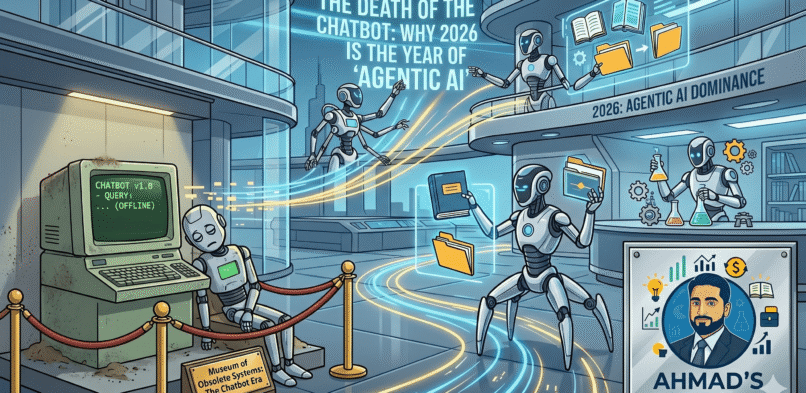
But as we enter 2026, the era of the “Chatbot” is officially ending.
We are no longer just talking to AI. The AI is now talking to other software, making decisions, and executing tasks without our constant supervision. Welcome to the year of Agentic AI, a shift that will redefine the global economy and drastically alter the landscape for Pakistan’s massive freelance workforce.
From Conversation to Action: What is an AI Agent?
To understand the shift, we must look at the difference between a Large Language Model (LLM) and a Large Action Model (LAM).
- The Chatbot Era (2023-2025): You say, “Write a cold email to a potential client in the real estate sector.” The AI writes it. You copy it, open your email client, find the email address, paste it, and hit send.
- The Agentic Era (2026): You say, “Find 50 real estate brokers in Dubai, scrape their contact info, write personalized cold emails to each based on their recent LinkedIn posts, send them at optimal times, and book any positive replies directly into my Google Calendar.” You step away. The AI executes the entire multi-step workflow.
Agentic AI doesn’t just generate text; it possesses autonomy, reasoning, and the ability to use external tools (APIs, browsers, databases) to achieve a broader goal.
The Threat: The End of “Basic” Freelancing
Pakistan is one of the world’s largest suppliers of gig-economy labor. For years, our digital exports have relied heavily on platforms like Upwork and Fiverr. However, the rise of Agentic AI is an extinction-level event for task-based freelancing. If your business model involves being the “middleman” between a client’s instruction and a digital output, your job is at risk.
Agents are rapidly wiping out demand for:
- Routine data entry and web scraping.
- Basic translation and transcription.
- Entry-level SEO content writing and social media scheduling.
- Simple UI/UX wireframing and boilerplate coding.
Western clients are no longer hiring freelancers to perform these tasks; they are deploying AI agents to do them instantly, flawlessly, and at a fraction of the cost.
The Opportunity: The Rise of the “AI Operator”
Does this mean the end of Pakistan’s digital economy? Absolutely not. It simply means the rules of the game have changed. The market is moving from “Selling Hours” to “Selling Outcomes.” The most successful professionals in 2026 will not be the ones who write the best code or draft the fastest articles. The winners will be the AI Operators who know how to build, deploy, and manage fleets of AI agents to solve complex business problems.
To thrive in the Agentic Era, Pakistani professionals must pivot:
- Stop selling the task, sell the system: Don’t offer “SEO writing.” Offer “Automated Organic Traffic Generation,” utilizing an agent you built to research, write, format, and publish.
- Learn Agent Frameworks: Familiarize yourself with platforms for building autonomous agents (such as AutoGPT, LangChain, or custom enterprise solutions).
- Elevate to Strategy: AI can execute the “how,” but it still needs a human to define the “why.” Strategic thinking, empathy, and high-level problem solving are the ultimate moats.
Conclusion: Adapt or Be Automated
The digital divide is no longer between those who have internet access and those who don’t. The new divide is between those who employ AI agents and those who are competing against them.
As we navigate 2026, we must critically review our workflows. Are you operating like a chatbot, waiting for a prompt before you do the work? Or are you operating like an Agent, autonomous, goal-oriented, and system-driven?
The future belongs to the operators.
Related Articles:

Leave a comment