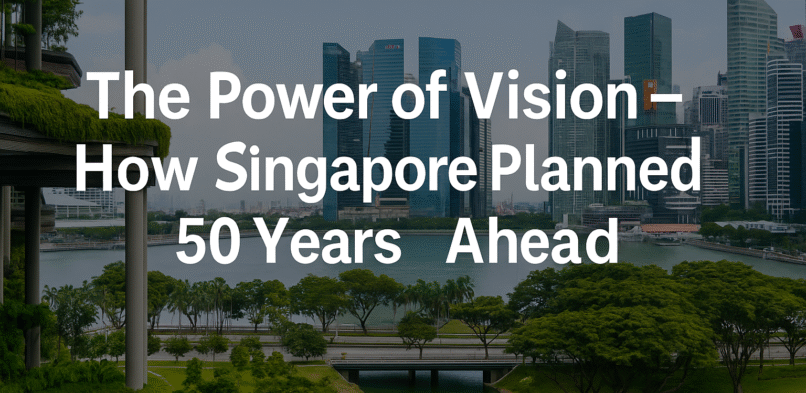
Most countries plan for five years. Singapore planned for fifty.
At a time when the world was still figuring out how to industrialize, Singapore’s leaders were already mapping the next five decades of urban life. They didn’t just react to challenges; they anticipated them. This long-term vision turned a small, resource-scarce island into one of the world’s smartest, cleanest, and most livable nations.
If Pakistan is to rise above urban chaos, pollution, and poverty, it must adopt a similar mindset: one of visionary, long-term planning rooted in technology, sustainability, and citizen wellbeing.
Why Long-Term Vision Matters
Short-term plans satisfy headlines. Long-term vision changes history.
Singapore’s Urban Redevelopment Authority (URA) develops plans that look 40 to 50 years into the future. These are not idle dreams; they are detailed blueprints based on data, growth patterns, climate projections, and technology trends.
These plans ensure:
- Land is used optimally.
- Infrastructure anticipates future needs.
- The city evolves with grace, not chaos.
By contrast, Pakistani cities expand haphazardly, and unregulated colonies, traffic congestion, and water shortages are all symptoms of a reactive system without a guiding map.
The Singapore Model: Vision in Action
Let’s break down how vision became action in Singapore:
✅ Master Planning Every Inch
Every parcel of land is planned for its most effective, sustainable use, commercial, residential, green space, or transport. It’s a living, evolving master plan.
✅ Mixed-Use Development
Singapore combines housing, retail, transport, and workspaces within walking distance. No need to travel hours for basic needs.
✅ Green Space Integration
From Day 1, Singapore prioritized green cover parks, vertical gardens, and even trees on rooftops.
✅ Underground Mastery
Singapore uses the underground not just for trains, but for expressways, shopping centers, and even data cable tunnels. This reduces surface congestion and maximizes usable land.
✅ Water Security Planning
By anticipating future scarcity, Singapore invested in NEWater (recycled water) and desalination, now key sources of drinking water.
What Happens Without Vision: Pakistan’s Urban Challenges
- Lahore’s green cover has dropped by over 70% in two decades.
- Karachi’s unregulated sprawl has created transport, sewage, and electricity nightmares.
- Islamabad’s zoning violations are eroding its planned character.
These are signs of planning gaps, not just resource constraints.
What Pakistan Can Do Differently: Vision 2040 for Cities
Here’s how Pakistan can start thinking like Singapore:
🔹 City Vision Councils
Establish permanent, non-political urban vision councils in every major city, made up of architects, data scientists, planners, engineers, and environmentalists.
🔹 Digital Urban Maps
Use GIS and AI to forecast population growth, land needs, and mobility patterns.
🔹 10-Year and 25-Year City Plans
Instead of scattered municipal plans, create layered blueprints:
- Short-term (5 years) – Urgent fixes
- Mid-term (10–15 years) – Infrastructure
- Long-term (25–40 years) – Smart city vision
🔹 Citizen Participation
Cities must grow with the people, not around them. Online forums, community planning workshops, and youth innovation hubs can democratize city planning.
A Glimpse Into a Future City of Pakistan
Imagine this:
It’s 2040. Islamabad has underground expressways, Karachi has smart water recycling, Lahore has forest-covered skyscrapers, and Faisalabad has AI-managed energy systems.
This is possible not through luck, but through vision + planning + action.
The Road Ahead
Pakistan’s urban future isn’t written yet. It can be chaotic or it can be brilliant.
Singapore teaches us that a 50-year plan is not a luxury, it’s a necessity. If we dream beyond our term limits, if we design beyond today’s problems, we can build cities that uplift generations.
Let’s begin with a bold question:
What will your city look like in 2075?
Related Article: Lessons from Singapore: Smart Cities for Pakistan

1 Comment
[…] The Power of Vision – How Singapore Planned 50 Years Ahead […]